

As a past founder and current Operating Partner at FutureSight Ventures, I’ve lived through the rollercoaster of building businesses from zero to one. I know firsthand the grit, the late nights, and the relentless problem-solving it takes to turn an idea into something real. That’s why I’m so passionate about the venture studio model, it’s a framework designed to give founders the tools, support, structure, and team they need to succeed faster and smarter.
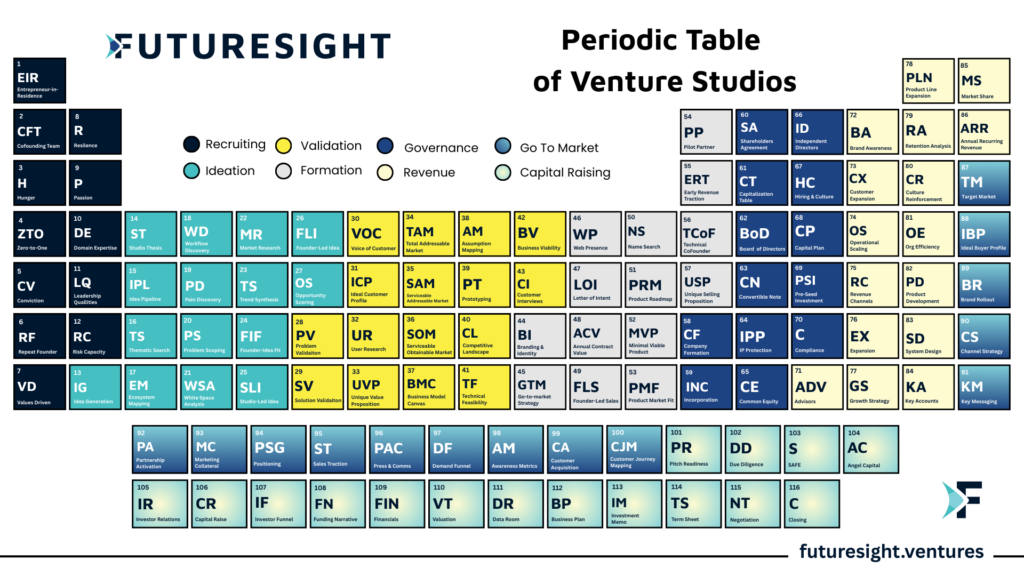
If you’ve ever dared to start a business from scratch, you know that having the right elements in place can make all the difference. That’s exactly what inspired our Venture Studio Periodic Table. Just like in chemistry, where the right elements combine in precise ways to create incredible reactions, the right components in a venture studio — from strategy to operations, product to growth, and capital formation — come together to spark extraordinary results.
This table isn’t just a visual guide; it’s your go-to reference for everything an Entrepreneur-in-Residence (EIR) needs to know to navigate the venture studio ecosystem effectively. Each “element” represents a critical aspect of building, scaling, and refining ventures, the foundational pieces that, when combined thoughtfully, generate impact far beyond the sum of their parts.
(Click on the image to enlarge)
Join the conversation, we’d love to hear your comments below: Click for the comment section.
Recruiting
Building the right team is the foundation of every venture. This category covers the strategies, roles, and processes essential to attract and retain top Founder talent.
1. EIR (Entrepreneur-in-Residence)
An experienced entrepreneur embedded in the studio to develop and launch new ventures.
2. CFT (Cofounding Team)
The core founding group responsible for building and leading the startup.
3. H (Hunger)
A strong internal drive to succeed and achieve ambitious goals.
4. ZTO (Zero-to-one)
The process of creating a completely new product, market, or business from scratch.
5. CV (Conviction)
Strong belief in the opportunity and willingness to pursue it decisively.
6. RF (Repeat Founder)
An entrepreneur who has previously started one or more companies.
7. VD (Values Driven)
Operating with clear principles that guide decisions and culture.
8. R (Resilience)
The ability to persist and adapt through setbacks and uncertainty.
9. P (Passion)
Deep enthusiasm and commitment to solving a specific problem or building a venture.
10. DE (Domain Expertise)
Specialized knowledge or experience in a relevant industry or field.
11. LQ (Leadership Qualities)
The skills and traits required to inspire, align, and guide a team.
12. RC (Risk Capacity)
The financial, emotional, and professional ability to take on startup risk.
Ideation
The spark of innovation begins here. Ideation focuses on generating, refining, and selecting ideas that have the potential to become high-impact, venture scale businesses.
13. IG (Idea Generation)
The structured creation of new venture concepts.
14. ST (Studio Thesis)
The strategic focus areas that guide what types of startups the studio builds.
15. IPL (Idea Pipeline)
A managed flow of potential startup ideas at various stages of development.
16. TS (Thematic Search)
Exploring opportunities within predefined industry or technology themes.
17. EM (Ecosystem Mapping)
Analyzing key players, trends, and gaps within a market landscape.
18. WD (Workflow Discovery)
Identifying inefficiencies or friction in existing processes.
19. PD (Pain Discovery)
Uncovering meaningful problems experienced by target users.
20. PS (Problem Scoping)
Clearly defining the boundaries and impact of a specific problem.
21. WSA (White Space Analysis)
Identifying underserved or untapped opportunities in a market.
22. MR (Market Research)
Collecting and analyzing data about customers and competitors.
23. TS (Trend Synthesis)
Combining emerging trends to uncover new venture opportunities.
24. FIF (Founder-Idea Fit)
Alignment between a founder’s skills and the startup opportunity.
25. SLI (Studio-Led Idea)
A venture concept generated internally by the studio.
26. FLI (Founder-Led Idea)
A venture concept proposed and driven by an entrepreneur.
27. OS (Opportunity Scoring)
Evaluating and ranking ideas based on attractiveness and feasibility.
Validation
Before scaling, assumptions must be tested. Validation ensures ideas are feasible, desirable, and aligned with market needs. If ideas don’t pass the stress test, they are killed.
28. PV (Problem Validation)
Confirming that a real and urgent problem exists.
29. SV (Solution Validation)
Testing whether a proposed solution effectively addresses the problem.
30. VOC (Voice of Customer)
Direct insights gathered from customers about their needs and experiences.
31. ICP (Ideal Customer Profile)
A detailed description of the most valuable target customer.
32. UR (User Research)
Systematic study of user behaviors, needs, and motivations.
33. UVP (Unique Value Proposition)
A clear statement of the distinct benefit offered to customers.
34. TAM (Total Addressable Market)
The total revenue opportunity if 100% of the market is captured.
35. SAM (Serviceable Addressable Market)
The portion of the TAM that the business can realistically target.
36. SOM (Serviceable Obtainable Market)
The share of SAM that can be captured in the near term.
37. BMC (Business Model Canvas)
A visual framework outlining how a business creates, delivers, and captures value.
38. AM (Assumption Mapping)
Identifying and prioritizing the key assumptions underlying a business idea.
39. PT (Prototyping)
Creating early versions of a product to test ideas quickly.
40. CL (Competitive Landscape)
Analysis of existing competitors and alternative solutions.
41. TF (Technical Feasibility)
Assessing whether the solution can be built with available technology.
42. BV (Business Viability)
Determining whether the venture can become financially sustainable.
43. CI (Customer Interviews)
Structured conversations with potential users to gather insights.
Formation
Turning an idea into a structured entity requires precise execution. Formation covers legal, operational, and structural steps to launch a venture effectively into the market.
44. BI (Branding & Identity)
The visual and strategic expression of a company’s brand.
45. GTM (Go-to-Market Strategy)
A coordinated plan to launch and sell the product successfully.
46. WP (Web Presence)
The company’s online visibility and digital footprint.
47. LOI (Letter of Intent)
A document expressing preliminary commitment from a customer or partner.
48. ACV (Annual Contract Value)
The yearly revenue generated from a customer contract.
49. FLS (Founder-Led Sales)
Early-stage sales conducted directly by the founders.
50. NS (Name Search)
Verifying the availability of a company or product name legally and digitally.
51. PRM (Product Roadmap)
A timeline outlining planned product features and milestones.
52. MVP (Minimal Viable Product)
The simplest functional version of a product used to test demand.
53. PMF (Product Market Fit)
The point at which a product strongly satisfies market demand.
54. PP (Pilot Partner)
An early customer who tests the product in a real-world setting.
55. ERT (Early Revenue Traction)
Initial proof of paying customers and revenue generation.
56. TCoF (Technical CoFounder)
A founding team member responsible for building and overseeing the product’s technology.
57. USP (Unique Selling Proposition)
A specific feature or benefit that differentiates the product from competitors.
Governance
Strong governance ensures ventures operate with clarity and accountability. This category covers decision-making structures, roles, and processes that maintain alignment and long-term sustainability.
58. CF (Company Formation)
The process of legally establishing a new business entity.
59. INC (Incorporation)
Registering the company as a legal corporation.
60. SA (Shareholders Agreement)
A contract outlining rights and obligations of shareholders.
61. CT (Capitalization Table)
A record of ownership stakes in the company.
62. BoD (Board of Directors)
A governing body providing oversight and strategic guidance.
63. CN (Convertible Note)
A loan that converts into equity at a later financing round.
64. IPP (IP Protection)
Safeguarding a company’s intellectual property through legal rights.
65. CE (Common Equity)
Standard shares representing ownership in a company.
66. ID (Independant Directors)
Experienced leaders providing oversight, guidance, and objective decision-making.
67. HC (Hiring & Culture)
Recruiting talent while building a strong workplace culture.
68. CP (Capital Plan)
A strategy for financing growth and operations.
69. PSI (Pre-Seed Investment)
Early capital raised to develop and validate the idea.
70. C (Compliance)
Processes and practices ensuring adherence to legal, regulatory, and ethical standards.
Revenue
Revenue drives the viability and scalability of a venture. This category focuses on monetization strategies, business models, and financial frameworks that generate sustainable growth.
71. ADV (Advisors)
Skilled professionals offering strategic advice and insights.
72. BA (Brand Awareness)
The level of market recognition of a brand.
73. CX (Customer Expansion)
Strategies aimed at increasing revenue from existing customers through upselling or cross-selling.
74. OS (Operational Scaling)
Expanding systems and processes to support growth.
75. RC (Revenue Channels)
Different streams through which the company earns income.
76. EX (Expansion)
Entering new markets or customer segments.
77. GS (Growth Strategy)
A plan to increase revenue and market share.
78. PLN (Product Line Expansion)
Adding new products or features to broaden offerings.
79. RA (Retention Analysis)
Measuring and improving customer loyalty
80. CR (Culture Reinforcement)
Actions and practices that strengthen and sustain a company’s core values and workplace culture.
81. OE (Org Efficiency)
Optimizing team structure and performance.
82. PD (Product Development)
Continuous improvement and building of the product.
83. SD (System Design)
Structuring scalable technical and operational systems.
84. KA (Key Accounts)
High-value customers critical to revenue growth.
85. MS (Market Share)
The percentage of total market sales captured.
86. ARR (Annual Recurring Revenue)
The predictable revenue a company expects to earn from subscriptions or contracts over a year.
Go-to-Market
Success depends on reaching the right audience. Go-to-Market focuses on positioning, marketing, and sales strategies that accelerate adoption.
87. TM (Target Market)
The defined group of customers the company aims to serve.
88. IBP (Ideal Buyer Profile)
A detailed profile of the decision-maker most likely to purchase.
89. BR (Brand Rollout)
The structured launch of a brand into the market.
90. CS (Channel Strategy)
The plan for reaching customers through distribution and marketing channels.
91. KM (Key Messaging)
The core messages used to communicate value to the market.
92. PA (Partnership Activation)
The process of launching and managing strategic collaborations to drive business value.
93. MC (Marketing Collateral)
Materials used to support sales and marketing efforts.
94. PSG (Positioning)
The strategy of defining how a brand or product is perceived in the minds of customers.
95. ST (Sales Traction)
The measurable progress and momentum of sales growth over time.
96. PAC (Press & Comms)
Managing media relations and public communication.
97. DF (Demand Funnel)
The structured process that tracks potential customers from awareness to purchase.
98. AM (Awareness Metrics)
Measurements that track visibility and reach in the market.
99. CA (Customer Acquisition)
The process of gaining new customers.
100. CJM (Customer Journey Mapping)
Visualizing the customer’s experience across touchpoints.
Capital Raising
Access to the right capital is critical for scaling. This category covers funding strategies, investor engagement, and structuring deals to support long-term growth.
101. PR (Pitch Readiness)
The thorough preparation and professional refinement of a company’s presentation for investors or stakeholders.
102. DD (Due Diligence)
The process of thoroughly investigating a company before an investment or business decision.
103. S (SAFE)
A Simple Agreement for Future Equity investment contract.
104. AC (Angel Capital)
Investment provided by individual early-stage investors.
105. IR (Investor Relations)
Managing communication and relationships between a company and its investors.
106. CR (Capital Raise)
The process of securing external funding.
107. IF (Investor Funnel)
The structured process of attracting, engaging, and converting potential investors.
108. FN (Funding Narrative)
A persuasive story that clearly conveys a company’s value, vision, and investment potential.
109. FIN (Financials)
The company’s financial statements and projections.
110. VT (Valuation)
The assessed monetary worth of the company.
111. DR (Data Room)
A secure repository of documents shared with investors.
112. BP (Business Plan)
A detailed document outlining a company’s goals, strategies, and roadmap for success.
113. IM (Investment Memo)
A summary document explaining the investment opportunity.
114. TS (Term Sheet)
A document outlining key investment terms.
115. NT (Negotiation)
The process of agreeing on deal terms.
116. C (Closing)
Finalizing and executing the investment agreement.
Want to learn more about FutureSight’s venture studio?
Discover What We Do and Who We Are. Sign up for our LinkedIn Newsletter, The FutureSight Spark.